You apply for a loan against mutual funds. The lender quotes you “Repo Rate + 3%.” Sounds simple. But what is that 3% actually doing there? Where does it come from? And could you have walked away with 2% if you had pushed a little harder?
That 3% is the spread in LAMF. It sits quietly inside your interest rate and decides more about your borrowing cost than most people realize.
Most borrowers look at the final number and move on. Very few ask what is inside it. That is exactly the gap this article closes.
How Does a LAMF Interest Rate Work?
A loan against mutual funds is a secured credit facility — you pledge your units, the lender gives you money, and your investment stays put. Since there is real collateral backing the loan, lenders do not charge you personal loan rates. The rate is meaningfully lower.
But it is not a single flat number either. It is built from two pieces:
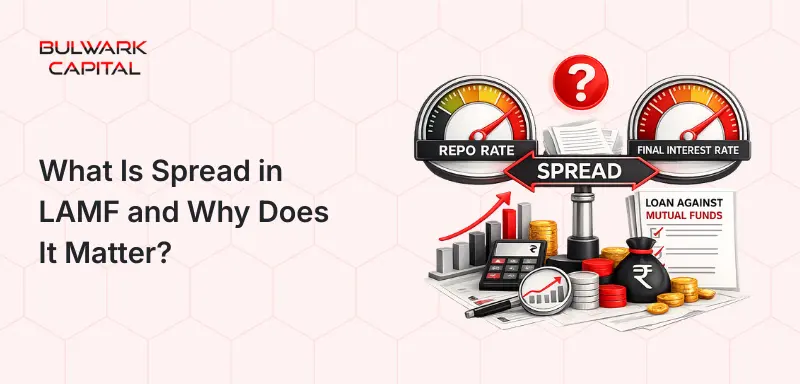
LAMF Interest Rate = Benchmark Rate + Spread
Two parts. Both matter.
What is the benchmark?
The benchmark is the reference rate your lender anchors to. Two common ones in India:
- Repo Rate — RBI sets this every two months through the Monetary Policy Committee. Right now it sits at 5.25% (April 2026), after coming down 125 basis points through 2025. Because it is public and predictable, repo-linked LAMF interest rates are easier for borrowers to track and understand.
- MCLR (Marginal Cost of Funds-based Lending Rate) — each bank calculates its own MCLR based on what it costs them to raise money. It is not public the way the repo rate is, and it only resets every 6 to 12 months. So even when RBI cuts rates, your LAMF interest rate tied to MCLR might stay unchanged for the better part of a year.
NBFCs sit outside this framework. They are not required to follow MCLR or repo-linked pricing, so they build rates using their own internal benchmarks. That flexibility is actually why NBFCs often price LAMF more competitively than banks for certain borrower profiles.
Numeric example:
Repo rate is 5.25%. Lender’s LAMF spread is 3.75%.
Effective Rate = 5.25% + 3.75% = 9%
RBI then cuts repo by 50 bps. Your rate drops to 8.5% — assuming your lender resets on time. Your spread of 3.75% did not budge. Only the benchmark shifted.
What Is Spread in LAMF?
The spread in LAMF is the fixed markup a lender charges over the benchmark. It is their margin — the portion of your interest rate that covers their costs and profit, and does not move when RBI changes policy.
What does the spread actually pay for?
- Operating costs — processing, documentation, lien management, system costs
- Profit margin — the lender’s return for deploying capital
- Risk premium — buffer against the chance you default or the fund’s NAV falls sharply
Why is the LAMF spread lower than on a personal loan?
Because your mutual fund units are sitting right there as security. A lender knows that if repayment stops, they can liquidate the pledged units and recover their money. That safety net does not exist on a personal loan — which is why personal loan rates run anywhere from 12% to 24%. The collateral in LAMF takes a big chunk of risk off the table, and the spread reflects that.
Does the spread move when the benchmark changes?
No — and this is the part most borrowers miss. Once the loan is sanctioned:
- The benchmark floats with market conditions
- The spread stays locked for the loan tenure
Repo Rate + 3.5% means your spread of 3.5% is fixed. What changes is whatever the repo rate does.
Real number example — rupee impact:
Two borrowers, same ₹5 lakh loan against mutual funds, same one-year tenure.
| Borrower A | Borrower B | |
| Benchmark | 5.25% | 5.25% |
| Spread | 3% | 5% |
| Effective Rate | 8.25% | 10.25% |
| Interest Paid (1 year) | ₹41,250 | ₹51,250 |
A 2% gap in LAMF spread costs Borrower B ₹10,000 extra. On ₹20 lakh over three years, that difference runs into lakhs.
Why Lenders Charge a Spread
The spread is not arbitrary. Every lender sets it based on real costs and calculations. Here is what goes into it:
- Cost of funds — what the lender itself pays to arrange capital before lending it to you
- Credit risk — probability of default based on your profile and the quality of collateral
- Operational overhead — the cost of managing the loan, maintaining lien records, tracking NAV, and handling margin call triggers
- Liquidity buffer — lenders keep a cushion for market volatility, particularly relevant with equity mutual funds where NAV can drop sharply
- Profit margin — lending is a business; the spread must generate returns for the lender
For a secured product like LAMF, these costs are relatively contained. That is why the loan against mutual funds spread is meaningfully lower than what you would see on a credit card or personal loan.
What Factors Decide Your LAMF Spread?
This is where most borrowers leave money on the table — by assuming the spread is fixed and non-negotiable. It is not. Several things shape what you are offered.
Type of Mutual Fund Pledged
- Debt mutual funds — stable NAV, lower volatility, lower collateral risk for the lender. Result: tighter spread, higher LTV.
- Equity mutual funds — NAV swings with markets, so the lender carries more risk. That gets priced into a slightly wider spread.
What about liquid funds?
Most lenders exclude liquid funds from LAMF collateral. Short duration, thin NAV buffer — operationally complicated for lenders to enforce collateral if something goes wrong.
Loan-to-Value Ratio
LTV is how much you borrow against your fund’s value.
- Equity mutual funds — RBI cap is 50% of NAV
- Debt mutual funds — lenders can go up to 80% depending on the fund
Borrow closer to the cap and the lender is more exposed. That exposure gets reflected in a wider spread. Keep your LTV at 35–40% and you have both a margin of safety and a stronger negotiating position.
Borrower’s Credit Profile
Secured or not, your CIBIL score still matters.
- 750+ signals clean repayment history — lender’s risk premium on the spread comes down
- Thin credit file or past defaults — expect a higher risk component built into the spread
The spread is not just about your collateral. It is also about you.
Bank vs NBFC
Banks:
- Price LAMF on MCLR + spread or repo-linked EBLR + spread
- Spread tends to be standardised, less room to negotiate
- Rate transmission is slow on MCLR-linked products
NBFCs:
- Use internal benchmarks, so they have more room to move
- Shorter-tenure borrowers often find NBFC pricing sharper than banks
- Some NBFCs offer fixed rate products — predictable cost for the full tenure
For smaller loan amounts taken for under a year, many borrowers end up paying less with an NBFC even if the bank’s brand name feels more reassuring.
Loan Amount and Tenure
- Pledge ₹2 crore worth of funds and you have room to negotiate. ₹10 lakh — not so much.
- Shorter loan window means less risk for the lender, often reflected in a tighter spread
- Longer tenures introduce more NAV uncertainty, which can push the spread wider
Fixed Spread vs Floating Rate
Here is how most loan against mutual funds products work:
Floating Rate = Benchmark (moves) + Spread (fixed)
In practice:
- LAMF at repo 5.25% + spread 3% = 8.25%
- Repo drops to 4.75% → rate becomes 7.75%
- Repo goes up to 5.75% → rate becomes 8.75%
The spread holds steady. Your rate moves only because the benchmark does.
Fixed Rate products:
Some NBFCs lock in the entire rate upfront — no movement regardless of RBI policy.
- Good for budgeting and certainty
- Not ideal if rates fall significantly during your tenure
Which suits whom?
- Under 12 months — fixed rate is fine; RBI rarely moves dramatically in a short window
- Medium to long tenure — floating rate with a known spread usually works better; you gain when the benchmark falls
- Cannot handle variability — fixed rate gives peace of mind even if it costs slightly more
Fixed Spread vs Fixed Rate — Not the Same Thing
People mix these up constantly. They are not the same.
Fixed Spread — your markup is locked, but the total rate still moves with the benchmark.
Repo (changes) + 3% (locked spread) = rate adjusts at reset dates
Fixed Rate — the entire rate is frozen. Benchmark changes are irrelevant to you.
9% p.a. fixed = 9% for the full tenure, no matter what RBI does
Example: ₹10 lakh LAMF taken in April 2025.
| Fixed Spread | Fixed Rate | |
| Rate at start | 5.25% + 3.5% = 8.75% | 8.75% |
| After RBI cuts 1.25% | 4% + 3.5% = 7.5% | 8.75% (unchanged) |
| Savings on ₹10L/year | ₹12,500 less interest | No savings |
Before signing, ask the lender directly: fixed spread or fixed rate? The answer changes how you should evaluate the offer.
How Spread Impacts Total Borrowing Cost
Take two borrowers. ₹8 lakh loan against mutual funds, 18 months.
| Component | Low Spread Lender | High Spread Lender |
| Benchmark | 5.25% | 5.25% |
| LAMF Spread | 2.75% | 5% |
| Effective Rate | 8% | 10.25% |
| Interest over 18 months | ₹96,000 | ₹1,23,000 |
| Processing Fee (0.5%) | ₹4,000 | ₹4,000 |
| Total Cost | ₹1,00,000 | ₹1,27,000 |
₹27,000 difference. Same loan, same duration, same fund type. Only the LAMF spread was different.
How to Compare LAMF Spread Across Lenders
Do not compare advertised rates. Compare the components.
- Ask for benchmark + spread separately — “9.5%” tells you nothing about structure. Ask what the benchmark is and what the spread is.
- Check if the spread can be revised — some lenders can widen the spread mid-tenure. If this clause exists, it should be capped.
- Calculate total cost — add processing fee, annual maintenance, renewal fees, and penal interest. Spread is the biggest cost but not the only one.
- Compare Effective Annual Cost (EAC) — two lenders at the same rate can have very different actual costs once fees are included.
Hidden costs to check:
- Processing fee: 0.35% to 1%
- Annual Maintenance / Renewal fee: charged yearly
- Penal interest: 2% to 3% extra per month on overdue amounts
- Pledge and de-pledge charges
Strategies to Obtain Lower Spreads
The LAMF spread is not always take-it-or-leave-it. Here is how to improve your position:
- Keep CIBIL above 750 — lenders price risk; a clean score reduces their risk premium
- Pledge debt funds — less volatility means less risk, often a tighter spread
- Borrow conservatively on LTV — 35–40% LTV gives you leverage to negotiate
- Go bigger on pledge amount — larger portfolios get better treatment
- Compare NBFCs — often more competitive than banks on spread, especially for shorter tenures
- Just ask — relationship managers sometimes have discretion of 25 to 50 basis points. You will not get what you do not ask for.
- Time it right — in a falling rate cycle, a floating rate product means your cost comes down without you doing anything
Conclusion
The spread in LAMF is where your real borrowing cost is built. Benchmark rates are outside everyone’s control. The spread is not.
Understand the formula, compare lenders on spread rather than headline rate, keep your LTV sensible, and negotiate — you will almost always borrow cheaper than someone who just accepted the first offer.
Bulwark Capital offers loan against mutual funds with transparent pricing and competitive LAMF interest rates — no hidden markups, no surprises. Your investments stay pledged and keep compounding while you get the liquidity you need. Visit bulwarkcapital.in to check your eligibility.