A loan against MF (Mutual Funds) is one of the smarter ways to access funds when you need liquidity. Your mutual fund units stay invested, returns keep compounding, and you borrow against what you already own without redeeming a single unit.
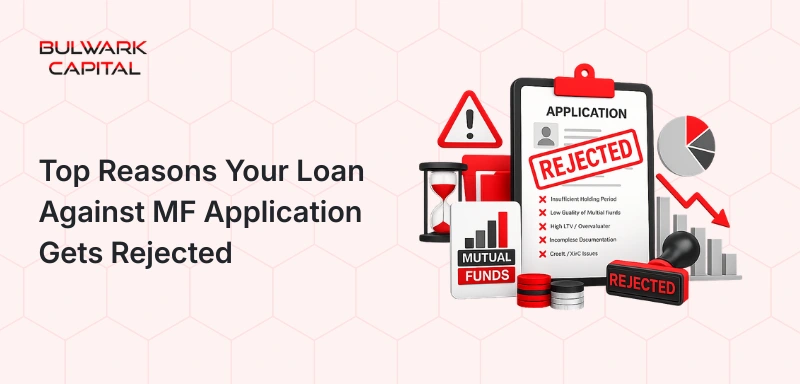
However, applications get rejected more often than people expect. And most of the time, it is not about portfolio size. It is about operational gaps, eligibility mismatches, and process errors that are entirely avoidable with the right preparation.
Approval depends on scheme eligibility, how lien marking goes through, your KYC status, holding structure, and lender-specific policies. This guide breaks down exactly what causes rejections so you can fix them before they become a problem.
Your Mutual Fund Scheme May Not Be Eligible for Financing
Not every mutual fund qualifies for a loan on a mutual fund. Lenders — banks and NBFCs alike — maintain approved lists of AMCs and specific schemes they accept as collateral. If your portfolio does not feature on that list, the application simply does not move forward.
Key restrictions to know:
- ELSS funds cannot be pledged during the mandatory 3-year lock-in period — units are not transferable until lock-in expires
- Thematic, sectoral, and international funds may fall outside a lender’s accepted categories due to valuation volatility
- Certain smaller or newer AMCs may not be serviced by CAMS or KFintech — and most lenders only process funds serviced by these two RTAs
- Equity and debt funds attract different eligibility treatment and different LTV margins
- Some lenders accept 5,000+ schemes; others maintain a much shorter approved list
Always check the lender’s current approved scheme list before applying.
Demat Holdings vs Folio-Based Holdings Can Delay Approval
How you hold your loan against MF units has a direct impact on loan processing speed.
| Holding Type | Processing | Common Friction Points |
| Folio-based (AMC direct) | Generally faster | Fewer intermediary steps |
| Demat-held units | Can be slower | Requires CDSL/NSDL coordination alongside CAMS/KFintech |
- Folio-based holdings can often be lien-marked more directly through CAMS or KFintech
- Demat-held units involve your Depository Participant (DP), which adds a coordination layer
- If your mobile number or email linked to the folio does not match lender records, portfolio data cannot even be fetched — the application stalls before it begins
- Some digital platforms fetch your holdings using your registered mobile via CAMS/KFintech; if that link is broken, you are invisible to the system
Confirm your holding structure with the lender and verify that your registered contact details match across folio and identity records before applying.
Lien Marking Issues With AMC or Registrar Verification
Before any loan against mutual funds is disbursed, the lender places a lien on your mutual fund units through CAMS or KFintech — the two RTAs that manage most mutual fund folios in India. The lien is marked against units, not the rupee amount. Until the loan is fully repaid, those units cannot be redeemed, switched, or transferred.
Where this breaks down:
- Folio details that do not exactly match lender records cause verification to fail
- A minor name discrepancy between your PAN and folio record is enough to interrupt the process
- Technical delays between the lender’s system and the RTA can hold up lien confirmation
- If the registrar cannot verify and confirm the lien, disbursal cannot happen even if everything else is in order
This is a late-stage failure point — investors often reach this step after submitting all documents and then face a hold they did not see coming. Verifying folio accuracy on MF Central before applying prevents most of these situations.
Joint Holding or Ownership Mismatch
Joint folios introduce requirements that solo holdings do not carry.
- Many lenders process applications only where the primary holder is the applicant — secondary or joint holders cannot apply independently
- Joint holders are typically required to provide consent for lien marking, which needs to be documented and submitted
- A name mismatch between borrower KYC documents and folio records is flagged immediately during verification
- Inherited or transferred folios may carry incomplete KYC from the original holder, requiring additional documentation before they can be pledged
Any ownership ambiguity between the folio and the borrower’s identity records will create a verification failure. Checking this alignment before applying saves significant time.
Low Eligible Portfolio Value After LTV Calculation
Your total portfolio value and your eligible loan amount are not the same number. Lenders apply an LTV — loan to value — ratio set under RBI guidelines.
| Fund Type | RBI LTV Cap | Typical Lender LTV |
| Equity Mutual Funds | 75% (RBI cap) | 45–50% in practice |
| Debt Mutual Funds | No RBI cap | Up to 75–80% |
| Hybrid Funds | Varies | Depends on equity-debt mix |
RBI has proposed revising the LTV cap for debt mutual funds to 75% and for equity to 60% — but lenders often apply conservative margins below these caps regardless.
Additional factors that reduce eligible value:
- NAV drops on a market-down day directly reduce your eligible credit limit
- If the loan amount drawn exceeds the revised eligible limit after an NAV fall, the shortfall is treated as overdue
- Portfolios below the lender’s minimum threshold — often around Rs. 50,000 — may not qualify at all
Running the lender’s LTV calculator before applying gives you the actual eligible number, not a rough estimate.
KYC or Investor Record Mismatch
KYC compliance is mandatory for pledging mutual fund units. PAN and full KYC are non-negotiable — without them, lien marking cannot even be initiated. This is one of the most common and most preventable rejection reasons in loan against mutual funds applications.
Common gaps that block applications:
- PAN mismatch between application and folio records
- Aadhaar not updated or not linked as per current SEBI norms
- Outdated bank account details in the folio
- Incomplete CKYC registration (Central KYC registry)
- Wrong mobile number or email linked — lenders use these to fetch portfolio data via CAMS/KFintech
- Signature mismatch between application and registered folio records
SEBI’s updated KYC norms require Aadhaar-based verification for mutual fund investments. Folios with outdated KYC are increasingly being flagged. A quick audit on MF Central — which covers both CAMS and KFintech-serviced folios — resolves most of these in one place.
Existing Debt or Credit Assessment Issues
A loan against MF is a secured product, but that does not mean lenders skip your financial profile entirely.
- Banks in particular review repayment capacity even when the loan is fully secured by pledged units
- High outstanding liabilities or active overdue obligations raise concern during assessment
- Some NBFCs run a basic credit check, especially for larger loan amounts
- Borrowers who are new to credit may face different processing under some lender policies
The loan amount for individuals under current RBI guidelines can go up to Rs. 20 lakh through banks, with proposals to raise this to Rs. 1 crore. At higher amounts, lender scrutiny on repayment capacity naturally increases. Going in with a clear picture of your existing obligations makes the process smoother.
Loan Against MF Interest Rate or Margin Terms Do Not Match Borrower Eligibility
Loan against MF interest rate structures vary significantly across lenders. LAMF is typically offered as an overdraft facility — you draw from a credit limit and pay interest only on what you use.
Typical interest rate range in India: 9% to 13% per annum for most banks and NBFCs — substantially lower than personal loan rates, which can run 12–24%.
Where this becomes a rejection or partial-sanction issue:
- An equity-heavy portfolio attracts a conservative LTV, reducing the sanctioned limit below what the borrower needs
- The applicable loan against mf interest rate at the eligible limit may not work within the borrower’s repayment plan
- Lenders may reduce sanction size if affordability concerns arise during review
- Borrowers expecting full portfolio value as eligible amount are often surprised by the post-margin figure
Comparing loan against mf interest rate structures and margin policies across at least two or three lenders before applying avoids this kind of post-application surprise.
Choosing the Wrong Lender or Platform
Not every lender works for every portfolio. Banks, NBFCs, and digital platforms follow different approval processes and maintain different scheme lists.
| Factor | Banks | NBFCs / Digital Platforms |
| AMC acceptance | Selective, often fewer | Generally broader |
| Processing speed | Slower, may involve manual steps | Faster, often fully digital |
| Minimum loan amount | Varies | Often starts at Rs. 10,000 |
| Credit score requirement | May apply | Often not required |
| Scheme list | Maintained internally | Broader but lender-specific |
Banks and several fintech-backed platforms, each has different AMC acceptance lists — an investor whose funds are not on a particular lender’s list will face rejection for a reason that had nothing to do with their portfolio quality.
Matching your specific fund holdings to the lender’s acceptance list is the most basic step before applying.
Ways to Improve Approval Chances Before Applying
A focused pre-application checklist cuts rejection risk significantly:
- Verify your funds appear on the lender’s approved scheme list
- Log into MF Central and confirm PAN, Aadhaar, bank account, mobile, and email are current and correctly linked across all folios
- Complete CKYC registration if not already done
- Use the lender’s LTV calculator to estimate your actual eligible amount, not the total portfolio value
- Factor in existing EMIs alongside the applicable loan against mf interest rate before committing
- If your portfolio is equity-heavy, check whether the post-LTV eligible amount meets your actual requirement
- Compare at least two lenders on scheme acceptance and processing experience — not just interest rate
- Keep PAN, Aadhaar, bank proof, and folio statements accessible before starting the application
Conclusion
Most loan against mutual funds rejections are predictable – and preventable. Wrong schemes, KYC gaps, lien marking failures, ownership mismatches and LTV shortfalls — these follow patterns that show up repeatedly.
A loan on MF structured correctly keeps your investments growing, gives you liquidity when you need it, and costs far less than a personal loan. The product works well when the groundwork is right.
Bulwark Capital helps investors work through eligibility assessment, lender matching, and the full pledge process — so your loan against mf units moves from application to disbursal without unnecessary delays. Visit bulwarkcapital.in to check what your portfolio qualifies for.