Most mutual fund investors focus on growing their portfolio. What fewer realize is that a well-built portfolio can do something else for you too—it can get you funds when you need them, without selling a single unit.
That is exactly what a Digital Loan Against Mutual Fund makes possible. You pledge your units, access a credit line, and your investments stay intact. The portfolio keeps compounding. You repay when it suits you.
Once you decide to go ahead with a LAMF, one decision needs your attention before anything else: should you go with a fixed interest rate or a floating interest rate?
This is not a minor detail. The rate type you choose directly affects your monthly outflow, your total borrowing cost, and how much financial flexibility you carry through the loan period.
By the end of this article, you will get clarity on how fixed and floating interest rate structures differ for a LAMF—and which one makes sense for your situation.
What is a Loan Against Mutual Funds Interest Rate?
Every time you draw money against your pledged mutual fund units, the lender charges you for it. That charge is not a processing cost or a one-time deduction—it is a rate applied on your outstanding borrowed amount, calculated daily.
That rate is your Loan against mutual funds interest rate. Put simply, it is what borrowing against your portfolio costs you annually, expressed as a percentage.
What separates LAMF interest rates from standard loan interest is how they are applied. A Digital Loan Against Mutual Fund runs on an overdraft model — your interest meter ticks only on the amount you have actually drawn.
If your sanctioned limit is ₹5,00,000 but you have used ₹1,00,000, you pay interest on ₹100,000—nothing more. Clear the balance early, and the interest stops right there.
This makes the Loan against mutual funds interest rate one of the most cost-efficient borrowing options available to investors today.
Types of Mutual Fund Loan Interest Rate
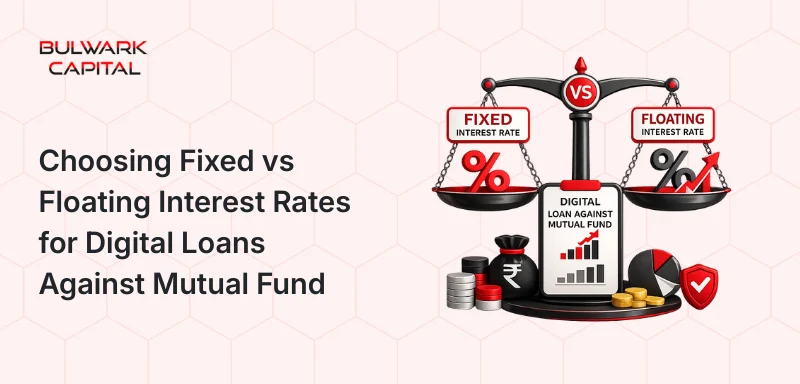
When applying for a LAMF, lenders offer the Mutual Fund Interest rate in two structures:
- Fixed interest rate — locked at sanction, does not change throughout the loan tenure
- Floating interest rate — linked to an external benchmark like the RBI repo rate and moves when the benchmark moves
Current Loan against mutual funds interest rates across banks and NBFCs in India range from 9% to 12% per annum, depending on the lender, fund type pledged, and borrower profile.
What is a Fixed Interest Rate on LAMF?
A fixed interest rate means the rate agreed on day one stays exactly the same for the entire loan tenure. Whether the RBI cuts rates, hikes them, or holds them steady — your cost of borrowing does not move.
You know the number on day one. It does not change.
How it Works — Example
You draw ₹2,50,000 from your LAMF credit line at a fixed interest rate of 9% per annum.
Monthly interest = ₹2,50,000 × 9% ÷ 12 = ₹1,875
Same number every month. No recalculations. No adjustments based on what the RBI does at its next meeting.
Pros of Choosing a Fixed Interest Rate
- Monthly interest cost is locked — straightforward to plan cash flows around
- No impact if the RBI raises the repo rate — your fixed interest rate stays exactly where it is
- You do not need to track monetary policy or market movements through your loan period
- Works well for short- to medium-duration borrowing needs
- Suits salaried borrowers and fixed-income earners who value predictability over flexibility
Cons of Choosing a Fixed Interest Rate
- If LAMF interest rates in the market fall, you do not benefit — your cost stays locked
- Starting rate may be marginally higher than some floating interest rate offerings
- Switching to a floating interest rate mid-tenure may attract a fee with certain lenders
What is a Floating Interest Rate on LAMF?
A floating interest rate on a LAMF moves with an external benchmark—typically the RBI repo rate or MCLR. When the benchmark changes, your Loan against mutual funds interest rate adjusts automatically, either upward or downward.
How it is Structured
Lenders express floating interest rates as: Repo Rate + Spread.
Say the repo rate is 5.25% and the lender’s spread is 3.75% — your effective LAMF interest rate is 9%. If the repo rate drops to 5.00%, your rate automatically becomes 8.75% with no action needed from your end.
The spread is usually fixed by the lender at the time of sanction. What moves is the benchmark component.
Current Rate Environment
The RBI’s June 2026 MPC meeting wrapped up with the repo rate held at 5.25% — no change. The committee flagged inflation concerns and kept its stance neutral. August 4–6, 2026, is when the next meeting happens, and that call could go either way. Borrowers on a floating interest rate LAMF should keep that date in mind.
Pros of Choosing a Floating Interest Rate
- If the RBI cuts rates, your Loan against mutual funds interest rate drops automatically
- It Often starts at a slightly lower rate than a comparable fixed interest rate offering
- Usually comes with no or minimal prepayment charges — exit when you want
- Works well for longer-tenure borrowers who can benefit from multiple rate cycles
Cons of Choosing a Floating Interest Rate
- Monthly outflow is unpredictable —making it harder to plan a fixed repayment schedule
- Rate hikes pass through directly and immediately to your LAMF interest rate
- Requires you to stay aware of RBI policy decisions through your full loan tenure
- In a rising rate environment, floating interest rate borrowers carry the full impact
Fixed vs Floating Interest Rate — Side-by-Side Comparison
| Parameter | Fixed Interest Rate | Floating Interest Rate |
| Rate movement | Unchanged throughout | Moves with repo rate / MCLR |
| Monthly outflow | Fully predictable | Variable — up or down |
| Benchmark linked | No | Yes |
| Benefits from rate cuts | No | Yes, automatically |
| Affected by rate hikes | No | Yes, directly |
| Budgeting ease | High | Moderate |
| Best suited for | Short tenure, fixed income borrowers | Longer tenure, flexible borrowers |
| Typical rate range | 9%–12% p.a. | Repo rate + lender’s spread |
| Prepayment charges | May apply | Usually nil or minimal |
Which One Should You Choose for Your LAMF?
The difference between fixed and floating interest rate on LAMF is not about which is objectively better. It is about which one fits your financial situation right now.
Go with a Fixed Interest Rate if:
- Your borrowing need is short — you plan to repay within 6 to 18 months
- You are on a fixed or salaried income and want your monthly outflow to stay constant
- You prefer not to monitor RBI decisions or market rate movements during your loan period
- The fixed interest rate being offered is competitive and locking it in makes clear financial sense
- Certainty matters more to you than the possibility of a slightly lower rate down the line
A fixed interest rate removes all variables from your borrowing cost. What you see on day one is what you pay throughout — no surprises.
Go with a Floating Interest Rate if:
- Your loan tenure is longer — between 18 months to 3 years — and you expect rate cycles to move in your favour
- You are financially flexible and can absorb a modest increase in outflow if rates rise temporarily
- You want the option to exit the loan early without a prepayment penalty
- You are confident the RBI rate environment will shift downward and want your floating interest rate to capture that benefit
The fixed vs floating interest rates decision comes down to one simple question: do you want full certainty, or are you willing to carry some variability in exchange for potential savings?
Factors That Influence Your Loan Against Mutual Fund Interest Rate
Your rate type choice is one piece of the equation. Several other factors determine the actual Mutual Fund Interest rate a lender will offer:
- Fund type pledged — Debt fund portfolios attract lower LAMF interest rates than equity portfolios. Equity funds carry higher NAV volatility and therefore higher lender risk — which gets reflected in the rate
- LTV ratio — A higher loan-to-value ratio means more risk exposure for the lender. This can nudge your Loan against mutual funds interest rate slightly upward
- Lender type — Banks typically offer LAMF interest rates starting from 8% to 10% p.a. NBFCs generally range between 9% and 12% depending on their cost of funds and credit policy
- Borrower credit profile — A solid CIBIL score and clean repayment history can support better rate negotiations, particularly with lenders who offer flexibility across fixed and floating interest rate products
- RBI rate environment at borrowing time — Borrowers who lock in a fixed interest rate during a high-rate cycle pay that cost throughout. Those who borrow during a low-rate period benefit from it for the entire tenure
These factors help you compare Digital Loans Against Mutual Funds across lenders meaningfully — not just the headline number but the real total cost of borrowing.
Things to Check Before Finalizing Your LAMF Interest Rate
Before you commit to any LAMF — whether fixed interest rate or floating interest rate — go through this checklist:
- Processing fee — Typically ₹500 to ₹1,500 plus GST. Factor it into your effective borrowing cost, not just the headline rate
- Prepayment and foreclosure charges — Especially important for fixed interest rate LAMF products. Some lenders charge 1% to 2% for early closure. Always confirm before signing
- Interest on drawn amount only — A properly structured Digital Loan Against Mutual Fund charges Loan against mutual funds interest rates only on what you have actually used. Do not assume this — confirm it explicitly with your lender
- Benchmark and revision frequency — For a floating interest rate product, ask which benchmark it tracks, how frequently revisions happen, and how quickly rate changes are passed on to you
- Spread fixity — In a floating interest rate structure, ask whether the spread is fixed for your tenure or whether the lender can revise it unilaterally
- Switch option — Some lenders allow a mid-tenure switch between fixed and floating interest rate structures. Check if this option exists and what it costs before committing
Conclusion
Choosing between fixed vs floating interest rates on a Digital Loan Against Mutual Fund comes down to three things — your loan tenure, your income stability, and your comfort with uncertainty.
A fixed interest rate is the right call when predictability matters most. You know your cost on day one, and it stays there regardless of what the market does.
A floating interest rate works better when your tenure is longer, you are financially flexible, and you want your LAMF interest rate to benefit automatically if rates fall.
Neither is a wrong choice. One just suits your situation better than the other.
For investors who want simplicity, speed, and zero ambiguity on cost, Bulwark Capital offers a fixed 9% p.a. LAMF interest rate — one of the most competitive rates among NBFCs in India today. Zero prepayment penalty, no hidden charges, and a fully digital process from eligibility check to disbursal. Your mutual fund units stay pledged, your portfolio keeps growing, and you receive funds typically within 4 hours of applying.
Visit bulwarkcapital.in, check your loan against mutual funds eligibility for free, and find out exactly how much your existing portfolio can unlock for you — without redeeming a single unit.