Margin Calls: You planned for repayments. You checked interest rates. You made sure the pledge process went through without a hitch.
What most Loan Against Mutual Funds borrowers do not plan for is the message that lands before markets open—after a bad session the previous evening. No warning. Just a number confirming your collateral has fallen short of your outstanding loan.
That is a margin call. This article tells you exactly what it is, what triggers it, how the process works, and how to stay well clear of one.
Here is what we cover:
- What is a margin call and how it works in LAMF
- Every trigger, including the quiet ones
- A real margin call example from the 2024 correction
- The buffer formula and how to use it
- How to respond if one arrives
- How to make sure one never does
What Is a Loan Against Mutual Funds — And Where Margin Calls Come In
A Loan Against Mutual Funds is built around one idea: ; borrow against what you already own, without selling it:
- Units pledged via CAMS or KFintech — lien marked directly on the folio
- OD limit sanctioned based on LTV applied to current portfolio value
- Interest charged only on what you use, only for the days you use it
- Units stay in your name, under your PAN — returns keep compounding
The One Clause That Changes Everything
Most borrowers read the interest rate and stop there. The part that actually matters day-to-day:
- Pledged collateral is revalued every business day on closing NAV
- Drawing power — what you can actually borrow that day — is recalculated every evening
- This is the exact mechanism behind every margin call
Why OD Loans Are More Dynamic Than Term Loans
Term loan: one variable—outstanding. Fixed and predictable.
OD-based Mutual Fund Loan: three variables at once—balance shifts with every draw and repayment, interest adds to outstanding daily, and NAV moves drawing power up or down every session. Watch only one of these, and the other two can still catch you short.
What Is a Margin Call : Definition and Key Terms
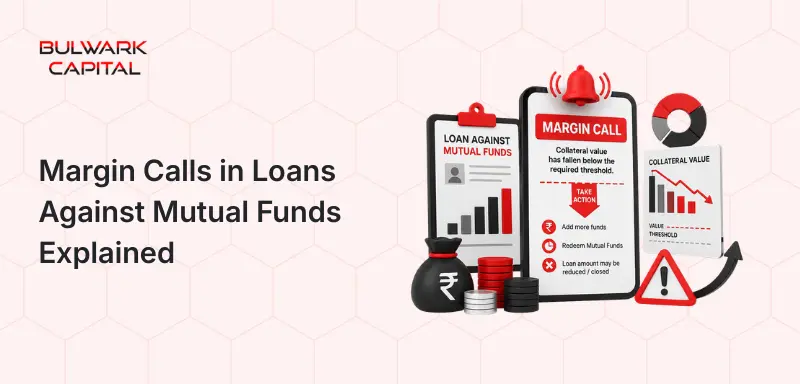
A margin call is a formal notice from your lender—issued when your outstanding loan balance crosses your revised eligible credit limit because the NAV of pledged funds has dropped.
Three things it means in practice:
- Collateral value has slipped below what your current outstanding requires
- The LTV ratio has breached the lender’s threshold
- You have a defined window to act before the lender does
It is not a default. It is a shortfall notice—with time to fix it.
Key Terms Every LAMF Borrower Must Know
| Term | What It Means |
| LTV (Loan-to-Value) | RBI ceiling — 50% for equity MFs, up to 80–85% for debt MFs |
| Drawing Power | Actual daily borrowing limit—recalculated every evening; different from your sanctioned limit |
| Maintenance Margin | LTV breach level that fires the margin call—check your specific loan agreement |
| Shortfall Amount | Gap between total outstanding (principal + interest + charges) and revised eligible limit |
When Does a Margin Call Occur
The Overnight NAV Drop
Markets close, NAV gets published by 9 PM, drawing power recalculates overnight, and the notice reaches you the next morning.
The process is fast and fully automated — which also means the response process is clear and structured.
Borrowers who understand the window and act early almost always resolve it without complication.
The Thin Buffer Trap
How much you have drawn against your limit directly decides how sensitive your account is:
- ₹4.9L drawn against ₹10L eligible limit—a 3% NAV fall creates a shortfall
- ₹3.5L drawn against the same ₹10L—needs a 30% fall before any breach
The buffer formula:
(Eligible Limit − Amount Drawn) ÷ Eligible Limit ÷ LTV% = NAV fall % needed to trigger breach
Staying under 70% utilization keeps most normal market swings from touching your account.
Sectoral and Thematic Fund Volatility
Sectoral funds move independently of the broader index. IT, pharma, PSU, and infra funds can fall sharply while Nifty stays steady. A diversified pledge—large-cap or flexi-cap—gives more stable drawing power and reduces sensitivity to single-sector moves.
Accrued Interest Adding to Outstanding
This one works silently:
- Outstanding = principal + accrued interest + charges
- Even with no new draws and no NAV fluctuations, unpaid interest keeps building
- On a flat day, interest accumulation alone can push the balance past drawing power
- Automated monthly interest payments eliminate this trigger completely
Fund Removed From Lender’s Approved List
- Lenders maintain an approved scheme list
- If a fund is removed—low AUM, AMC restructuring, regulatory changes—its value is excluded from collateral immediately
- A shortfall can arise even when there has been no market movement
- The first indication for most borrowers is the margin call notice itself
Margin Call Example — September–October 2024 Correction
The Setup
- Investor pledges ₹20L in a flexi-cap fund near Nifty’s September 2024 peak of 26,277
- 50% LTV → eligible limit = ₹10L
- ₹9.5L drawn — ₹50,000 buffer remaining
What Happened
- Fund NAV fell ~14% over October–November 2024 as Nifty corrected ~12%
- Portfolio value: ₹20L → ₹17.2L | New eligible limit: ₹8.6L
- Outstanding: ₹9.5L | Shortfall: ₹90,000
- Margin call issued Day 1–2 post revaluation
Had utilization been at 70% (₹7L drawn), drawing power would have settled at ₹8.6L—still above outstanding. Zero margin call. Identical fund, identical market—different result because of one number.
The Notice Contained
- Pledged portfolio value: ₹17.2L | Revised drawing power: ₹8.6L
- Shortfall: ₹90,000 | Response window: 5–7 business days
Margin Call Process — Stage by Stage
Stage 1 — Daily Monitoring
Every evening after NAV publishes, the lender’s system revalues the pledge and recalculates drawing power against outstanding. Runs for every active account, every business day.
Stage 2 — Deficiency Flagged
If outstanding crosses revised drawing power, the system automatically marks a shortfall. No manual step required.
Stage 3— Notification
Margin call notice delivered via SMS, email, and loan app—typically within 1–2 business days of the breach.
Stage 4 — Grace Period
The borrower gets 5–7 business days to respond. If markets recover during this window and LTV normalizes on its own, the call resets automatically—no action needed from you.
Stage 5 — Corrective Action: Three Options, Ranked
- Pledge additional mutual fund units—Best option. Restores LTV without reducing the loan. Use lender-approved holdings sitting outside the current pledge. Works well when you expect the market to recover—loan stays intact, collateral improves.
- Partially repay the outstanding loan. Brings the balance below the revised drawing power directly. Best when the correction looks like it has not bottomed yet and further NAV drops are possible.
- Accept partial liquidation—last resort only. The lender redeems just enough units at the current NAV to close the margin shortfall. You have no control over which funds are sold, at what price, or in what sequence. Use only when the first two options are genuinely not available within the grace period.
What Happens If a Margin Call Is Ignored
If the grace period passes without a response:
- Lender redeems the minimum number of units needed to restore LTV—not the full pledge
- Large, liquid, open-ended funds get selected first based on redemption speed
- The redemption appears in your name—full tax liability applies regardless of who triggered the sale
Tax consequences (post Union Budget 2024):
- Equity funds with a holding period under one year—gains fall under short term capital gains, currently taxed at 20%
- Equity funds held beyond one year—qualifies as long-term, taxed at 12.5% after the ₹1.25L annual threshold
- Debt funds acquired after April 1, 2023 — all gains treated as regular income and taxed at the investor’s applicable slab rate; no holding period benefit
- For SIP-based pledges, the FIFO method applies—units purchased earliest get redeemed first
The tax entry lands in your ITR for that financial year. A lender-initiated sale carries no exemption.
Margin Calls Across Different Mutual Fund Categories
Not all funds carry the same margin call risk. Here is how the major categories compare:
| Fund Category | Typical LTV | Margin Call Risk | Why |
| Large Cap Equity | 50% | Moderate | Index-linked; corrections are broad and recoverable |
| Flexi Cap / Multi Cap | 50% | Moderate | Spread across market caps; less concentrated |
| Small & Mid Cap | 50% | High | Can shed 20–30% in a single correction cycle |
| Sectoral / Thematic | 50% or lower | Very High | Sector-driven crashes operate independently of Nifty |
| Hybrid / Balanced | 60–70% | Low–Moderate | Sector-driven crashes operate independently of Nifty |
| Debt (Liquid / Ultra Short) | Up to 80–85% | Very Low | Barely moves; most predictable collateral type |
What this tells you practically:
- Small- and mid-cap pledges need noticeably wider buffers than large-cap ones
- Sectoral funds as primary collateral at high utilisation is a concentrated risk
- Mixing debt MF units into the pledge stabilises drawing power through volatile periods
The Buffer Math—Your Margin Call Safety Zone
| Utilisation Level | NAV Fall Needed to Breach |
| 95%—₹9.5L drawn vs ₹10L limit | ~10% fall triggers shortfall |
| 70% — ₹7L drawn vs ₹10L limit | ~30% fall needed |
| 50%—₹5L drawn vs ₹10L limit | ~50% fall needed |
The 70% rule: On an equity MF pledge, never draw beyond 70% of the eligible limit. That one habit covers most market scenarios without requiring active management.
Why a Mixed Pledge Works Better
Debt MF NAVs—liquid funds, ultra-short duration—move almost imperceptibly during equity corrections. Folding them into your pledge raises the total eligible limit while keeping drawing power stable.
Result: more room to borrow, less exposure to market-driven shortfalls.
Common Myths About Margin Calls
“It only happens during major crashes.”
A 10% correction—the kind that happens in an average year—is enough at 95% utilization. You do not need a once-in-a-decade event for this to affect you.
“My sanctioned limit is fixed.”
The sanctioned limit is the maximum ceiling. Drawing power is the daily working number — and it moves every evening. Most borrowers treat them as the same figure. They are not.
“There will be enough time to arrange funds after the notice.”
The window is 5–7 business days. If the market keeps falling during that period, the shortfall grows. Acting on Day 1 is meaningfully different from acting on Day 6.
“The lender will give me more time if I ask.”
The process runs on a defined schedule. Past the grace period, liquidation proceeds automatically without a second notice.
“Taxes won’t apply since I didn’t choose to sell.”
The sale sits in your name regardless of who initiated it. Capital gains treatment applies based on holding period—no carve-out for involuntary redemptions.
How to Prevent Margin Calls—Before You Draw
These practices, built in upfront, keep margin call territory comfortably distant:
- Draw below 70% of the eligible limit on equity pledges—always.
- Pay interest every month without fail—unpaid interest compounds into outstanding silently
- Diversify the pledge—combine large-cap or flexi-cap equity funds with debt MF holdings
- Avoid using sectoral or small/mid-cap funds as your primary collateral at high utilisation
- Check drawing power weekly, not just NAV—they move differently and both matter
- Keep unlocked MF holdings available—gives you an immediate pledge-to-top-up option if needed
- Review your lender’s approved scheme list periodically—removal of one fund can create an instant shortfall with zero market movement
Conclusion
A margin call in a loan against mutual funds is not a crisis—it is a predictable event with a structured resolution process. The borrowers who run into problems are almost always the ones who drew too close to their limit, left interest unpaid, or never looked at their drawing power between statements.
The fix is straightforward: stay under 70%, service interest monthly, and keep some reserve capacity in your pledge.
If you are looking for a mutual fund loan built around clarity and speed, Bulwark Capital offers loans against your mutual fund holdings with a process that is simple from application to disbursal. Your investments keep compounding. Your liquidity needs get met. Visit bulwarkcapital.in to check eligibility.