A Loan Against Mutual Funds gives investors access to funds without redeeming their portfolio. It is, arguably, one of the most efficient borrowing options out there right now. Interest rates are competitive, disbursal is fast, and most of the process happens on your phone or laptop.
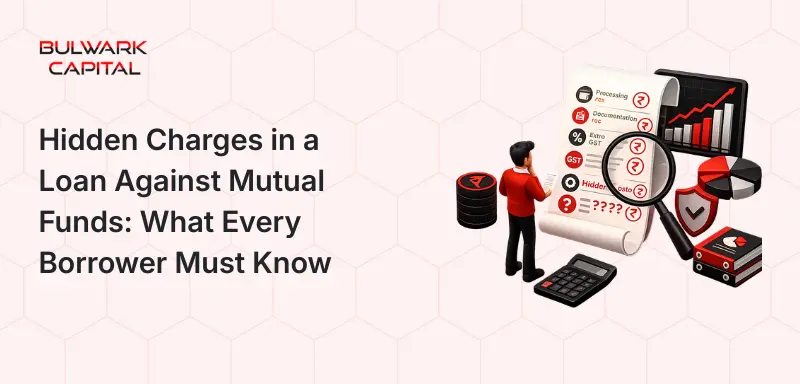
But here’s the thing. The headline interest rate is only one part of the total cost of a LAMF. There are several charges that sit quietly alongside it. Some are disclosed clearly. Some are buried deep in the fine print, and borrowers only notice them at disbursal or at closure.
This article walks through every charge a LAMF borrower should know about — what it is, when it kicks in, and what it usually costs.
Why the LAMF Interest Rate Is Not the Full Picture
Most people compare lenders based only on interest rate. That’s the first mistake.
The real cost of a Loan Against Mutual Funds is interest plus every applicable fee added on top. Two lenders quoting the exact same LAMF interest rate can end up costing you very differently once you add their fee structures.
The RBI now mandates a Key Fact Statement (KFS) for every borrower. It lists all charges upfront, in one place. Ask for it before you sign anything.
Understanding each of these charges is what actually helps you compare Loan Against Mutual Funds options the right way.
Processing Fee for Loan Against Mutual Funds
This is a one-time fee charged when your loan is sanctioned or disbursed. It covers the lender’s cost of evaluating your application and setting up the overdraft facility. An important point — it’s charged on the sanctioned limit, not necessarily on the amount you actually draw.
Typical range and real numbers
- Banks: 0.25% to 1% of the sanctioned limit
- NBFCs and digital lenders: a flat fee of ₹499 to ₹4,999 plus 18% GST, or 1% of the loan amount, whichever is higher
Example: a ₹10 lakh loan at 1% processing fee works out to ₹10,000 + 18% GST, which is ₹11,800 gone before you’ve even touched the money.
What to watch for
- The fee applies to your sanctioned limit, not the amount drawn — so drawing less doesn’t reduce this fee
- Some lenders deduct the processing fee straight from the loan disbursal, so your net disbursed amount is lower than the actual loan amount
- Always confirm whether GST is included in the quoted fee or charged on top
Annual Maintenance / Account Maintenance Fee (AMC)
This fee is charged annually, to maintain the overdraft account linked to your LAMF. It’s different from the processing fee because it recurs every year instead of being a one-time charge. You’ll often see it listed as “Annual Maintenance Charge” or “Facility Fee” in the loan documents.
Typical range
AMC usually falls between ₹500 and ₹2,000 per annum, plus GST. Some lenders bundle it into the processing fee for the first year , then start charging it separately from the second year – onward.
What to watch for
- If your LAMF tenure runs for 2-3 years, this charge compounds across every year
- Borrowers who renew their LAMF annually end up paying the AMC each time, and it adds up
- It rarely gets mentioned prominently in the headline offer, so most borrowers simply miss it
Renewal Fee of Loan Against Mutual Funds
Most LAMF facilities run on a 12-month tenure that gets renewed annually. At renewal time, lenders charge a renewal or rollover fee to extend the facility. They will also reassess your portfolio value and LTV before approving the renewal.
Typical range
Renewal fees usually sit between 0.25% and 0.50% of the sanctioned limit, though some lenders charge a flat fee instead. A few waive this fee altogether if your Loan Against Mutual Funds repayment record is clean.
What to watch for
- If you’re planning to hold the LAMF beyond 12 months, treat the renewal fee as a guaranteed recurring cost and budget for it upfront
- Renewal isn’t automatic everywhere — some lenders will ask for fresh documentation before extending it
Stamp Duty
Stamp duty is a statutory charge levied by state governments on the loan agreement and the lien marking documents. This isn’t a lender fee — it’s a legal requirement that is applied at the time your loan agreement gets executed.
Typical range
- It varies by state, but typically falls between ₹100 and ₹500 on the agreement
- Some states charge it as a percentage of the loan amount instead
- Digital LAMF platforms usually handle stamp duty through e-stamping, but the cost still gets passed on to you
What to watch for
It’s a relatively small number, which is exactly why borrowers often overlook it. Ask your lender for a full break-up of every statutory charge before signing.
Penal Interest and Overdue Charges
This gets charged when your monthly interest payment isn’t made on time. It also applies if your outstanding loan exceeds the LTV limit because of a fall in NAV, and you don’t respond within the given timeframe.
Under RBI’s 2023 circular, lenders can no longer charge “penal interest” as such. They now levy a flat “penal charge” on the overdue amount instead, and this charge cannot be compounded or added to your principal.
Typical range
- 1.5% to 3% per month on the overdue amount
- A bounce charge of ₹500 to ₹1,200 per instance, plus GST, if your NACH auto-debit fails
What to watch for
- A failed NACH debit (simply not having enough balance on the debit date) can trigger both a bounce charge and a penal charge in one go
- Keep sufficient balance in your account around the 2nd or 3rd working day of the month, when interest debits usually happen
- An LTV breach from a market fall also attracts penal charges if you don’t act in time — margin calls aren’t just about losing collateral, they cost real money too
Foreclosure and Prepayment Charges
This is charged if you close your LAMF before the tenure ends by repaying the full outstanding principal. For overdraft-based LAMF (the most common structure), most lenders don’t charge anything for foreclosure. Term-loan structured LAMF, which is less common, sometimes carries a foreclosure charge.
Typical range
- Overdraft LAMF: usually nil, or a minimal flat charge of ₹0 to ₹500
- Term loan LAMF: 1% to 2% of the outstanding principal in some cases
What to watch for
Confirm whether your LAMF is overdraft-based or term-loan based before you apply. Also ask specifically about any lock-in period — some lenders impose a 1-3 month lock-in, after which prepayment becomes free.
Non-Utilization Charge (NUC)
This is a charge on the unutilised portion of your sanctioned LAMF limit. Say your sanctioned limit is ₹5,00,000 but you’re only drawing ₹1,00,000 — some lenders will charge you a fee on the remaining ₹4,00,000 sitting idle. Not every lender charges this, but a few banks do.
Typical range
0.25% to 1% per annum on the unutilised portion. This can make a real cost difference for borrowers who take a large sanctioned limit “just in case” but end up drawing only a small fraction of it.
What to watch for
If you’re sanctioning a big LAMF limit for future flexibility, check whether your lender applies a non-utilization charge. It’s usually smarter to sanction a limit closer to your actual need if NUC applies to your lender.
Lien Marking and Release Charges
When you pledge your mutual fund units, a lien gets marked by CAMS or KFintech — the registrar — in favour of the lender. Some lenders pass this processing cost on to the borrower, either as a one-time charge or per folio basis.
Typical range
- Mostly nil with digital LAMF platforms, since the lender absorbs this cost
- Some traditional bank-based LAMF products charge ₹50 to ₹500 per folio, or a flat lien marking fee
What to watch for
If you’re pledging multiple folios across different AMCs, these charges can add up quickly. Also check whether there’s a separate release charge when the loan closes — some lenders charge extra just to unlock the lien.
Checklist — What to Ask Your Lender Before Signing
- What is the processing fee, and does it include GST?
- Is there an annual maintenance or facility fee?
- What are the renewal charges if I extend beyond 12 months?
- What is the penal charge for delayed interest payment?
- What is the bounce charge if NACH fails?
- Are there foreclosure or prepayment charges?
- Is there a non-utilisation charge on my sanctioned limit?
- Are there any lien marking or lien release fees?
- Will all of this be listed in the Key Fact Statement (KFS)?
Bulwark Capital’s Loan Against Mutual Funds Charges — Full Breakup
Visit Bulwark Capital’s Loan Against Mutual Funds Processing Fees & Other Charges page to review all applicable fees. We believe in complete transparency, with no hidden charges, so you always know exactly what you’re paying for and can borrow with confidence.
Conclusion
To recap — a LAMF is still one of the most cost-effective ways for mutual fund investors to borrow. But its true cost is interest plus every applicable charge sitting behind it, not just the number in the ad.
The smart move is always to calculate the full cost, not just the rate. Borrowers who read the KFS, ask the right questions, and compare total costs instead of headline rates come out ahead, every time.
Bulwark Capital keeps this simple with transparent pricing, zero prepayment charges, and no hidden costs — what you see is genuinely what you pay.
Check your loan against mutual funds eligibility at bulwarkcapital.in.