Mutual fund investors in India today have access to a borrowing facility that most still underutilize — a Loan Against Mutual Funds. Pledge your units, get a credit line, and your investments continue growing in the background. No redemption, no tax event and no disruption.
Once your loan is processed, then this decision will shape your entire borrowing experience: which loan repayment option to go choose with— EMI repayment or interest-only repayment.
Both options are available in the market. Both serve a purpose. The right one depends on your income pattern, your borrowing timeline, and how you plan to repay or close the loan.
This article breaks down both Loan Against Mutual Funds repayment structures clearly — so you can choose the one that fits your financial situation.
How Does Loan Against Mutual Funds Repayment Work?
A Loan Against Mutual Funds is not a traditional term loan. It functions as an overdraft facility — you get a pre-approved credit limit against your pledged units and draw from it as needed. Interest is only levied on the amount you use, not on the full sanctioned limit.
This structure makes Loan Against Mutual Funds repayment different from a personal loan or home loan, where repayment begins immediately on the full disbursed amount.
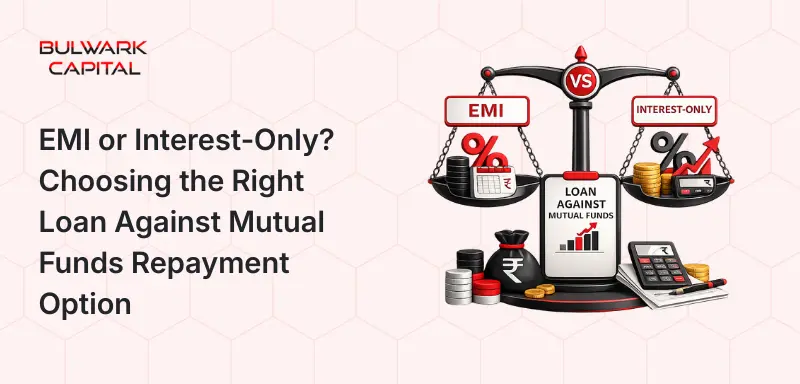
With LAMF, two repayment structures are available:
- Interest-only loan repayment — monthly interest payment on the drawn amount; principal repaid separately at tenure end or anytime in between
- EMI repayment — fixed monthly payment covering both interest and principal, reducing the outstanding balance progressively
Most banks and NBFCs offering LAMF default to the interest-only loan repayment model, given the overdraft nature of the product. Select lenders also offer an EMI repayment option for borrowers who prefer a structured paydown schedule.
What is Interest-Only Loan Repayment on LAMF?
In interest-only loan repayment, only the interest component is considered to be paid every month. The principal remains outstanding throughout the tenure and is repaid either in a lump sum at maturity or in parts at any point during the loan period — at the borrower’s discretion.
The calculation of Interest is on the drawn amount daily and auto-debited monthly, typically on the 2nd or 3rd working day of the following month.
How it Works — Example
Suppose if you draw ₹10,00,000 from your LAMF credit line at 9% per annum.
Monthly interest only repayments = ₹10,00,000 × 9% ÷ 12 = ₹7,500
The principal of ₹10,00,000 stays outstanding and is repaid when funds are available — a bonus, a receivable, a business inflow, or any lump sum.
Compare this to EMI repayment on the same ₹10,00,000 over 12 months — the monthly outflow would be approximately ₹87,500. The difference in monthly commitment is significant.
Pros of Interest-Only Loan Repayment
- Monthly outflow is minimal — preserves cash flow for other business or personal needs
- Principal can be repaid in parts or in full anytime — zero prepayment penalty with most lenders
- Well-suited for borrowers with variable or irregular monthly income
- Mutual fund portfolio continues compounding through the full loan tenure
- Functions as a revolving facility — repaying principal reopens the credit limit for future use
Cons of Interest-Only Loan Repayment
- Principal does not reduce month by month — outstanding balance stays constant until actively repaid
- Total interest paid over the full tenure is higher than EMI repayment, since the principal is not progressively reducing
What is EMI Repayment on LAMF?
EMI repayment is a fixed monthly payment that covers both interest and a portion of the principal. Each month, the outstanding principal reduces — and with it, the interest component of subsequent payments. This is the reducing balance method, the same structure used in personal loans and home loans.
How it Works — Example
Same ₹10,00,000 borrowed at 9% per annum, this time on EMI repayment over 12 months.
Monthly EMI = approximately ₹87,500
Each payment contains an interest component and a principal component. The interest portion reduces every month as the outstanding balance comes down. By the end of tenure, the loan is fully closed — no lump sum required.
Pros of EMI Repayment
- Loan closes progressively — no large one-time payment at the end of tenure
- Total interest paid is lower than interest-only loan repayments because the principal reduces each month
- Predictable repayment schedule — easy to plan monthly finances around a fixed number
- Clean loan closure at end of tenure without requiring active principal management
- Suits borrowers who prefer a defined end date and structured exit
Cons of EMI Repayment
- Monthly outflow is significantly higher than interest only repayments
- Creates cash flow pressure for self-employed or variable income borrowers
- Less flexibility — if income is disrupted in a particular month, a high fixed EMI repayment is harder to manage
- Not all LAMF lenders offer this structure — availability depends on the lender’s product design
EMI vs Interest-Only Repayment — Side-by-Side Comparison
| Parameter | EMI Repayment | Interest-Only Loan Repayment |
| Monthly outflow | High — principal + interest | Low — interest only |
| Principal reduction | Progressively, every month | Only when borrower actively repays |
| Total interest paid | Lower | Higher |
| Flexibility | Fixed schedule | Repay anytime, any amount |
| Best suited for | Fixed income, planned expenses | Variable income, short-term needs |
| Loan closure | Automatic at end of tenure | Requires active principal repayment |
| Prepayment charges | May apply with some lenders | Usually nil or minimal |
| Cash flow impact | High monthly pressure | Minimal monthly pressure |
Which Repayment Option Suits You?
The EMI vs Interest-Only repayment decision is not about which option looks better in a table. It is about which one matches your income pattern and repayment plan.
Go with Interest-Only Loan Repayment if:
- Your income is irregular — business owner, freelancer, or self-employed professional
- You are using LAMF to bridge a short-term cash flow gap and expect a specific inflow to repay the principal
- You want the lowest possible monthly commitment so the loan does not strain regular expenses
- You plan to use LAMF as a revolving overdraft — draw when needed, repay when possible
- Your tenure is short (3–12 months) and you have a clear plan for principal repayment
Go with EMI Repayment if:
- You have a fixed monthly salary and want a structured, predictable repayment plan
- You prefer the loan to close automatically at the end of the tenure with no lump sum due
- You are borrowing for a defined, one-time expense with a clear repayment timeline
- You want the total interest cost to be lower over the full tenure
- You prefer building a consistent repayment record with your lender
Key Things to Check Before Finalizing Your LAMF Repayment Option
- Availability of both structures — Confirm whether your lender offers EMI repayment, interest-only loan repayment, or both before applying
- Interest debit date — For interest only repayments, interest is typically auto-debited on the 2nd or 3rd working day of the following month. Ensure your account has sufficient balance on that date
- Prepayment charges — Some lenders charge a penalty for early closure on EMI repayment products. Confirm this before signing loan agreement
- Principal renewal option — For interest-only loan repayment, ask your lender whether the tenure can be renewed if the full principal is not repaid at maturity
- Margin call terms — If pledged fund NAV drops and LTV breaches the lender’s threshold, partial principal repayment or additional pledging is required under both structures. Know the response timelines — typically up to 7 days
- Missed payment penalty — Overdue charges on a missed EMI repayment are typically higher than a delayed interest debit. Understand the penalty structure upfront
- NACH mandate amount — Ensure your auto-debit mandate is set timely— especially for EMI repayment, where the monthly debit amount is fixed and higher
Conclusion
Choosing the right Loan Against Mutual Funds repayment structure is a straightforward decision once the two options are clearly understood.
Interest-only loan repayments keep monthly outflow low and give you complete flexibility on principal repayment — the right fit for variable income borrowers and short-term borrowing needs. EMI repayment brings structure and a lower total interest cost — better suited for fixed income borrowers who want a defined closure timeline.
At Bulwark Capital, the LAMF operates on both interest-only loan repayment & EMI repayment model — interest charged at a fixed 9% p.a. only on the amount utilised, zero prepayment penalty, and a fully digital process from application to disbursal.
Visit bulwarkcapital.in to check your LAMF eligibility and see how much your existing portfolio can unlock — without redeeming a single unit.