You took a Loan Against Mutual Funds. Smart move. Your units stay invested, interest rates are low, and the whole process is digital. But there is one thing most borrowers learn about only after it happens — a margin shortfall.
This guide tells you exactly what it is, why it happens, what it costs you, and how to stay ahead of it.
What Is Margin Shortfall in LAMF?
Your loan against mutual funds is not a one-time calculation. The lender keeps revaluing your pledged units every single day — based on the current NAV.
The amount you can borrow is always tied to a percentage of that daily value. This is called the Loan-to-Value ratio, or LTV. For equity mutual funds, RBI caps LTV at 50% for NBFCs. Most lenders operate at 45% to keep a built-in buffer.
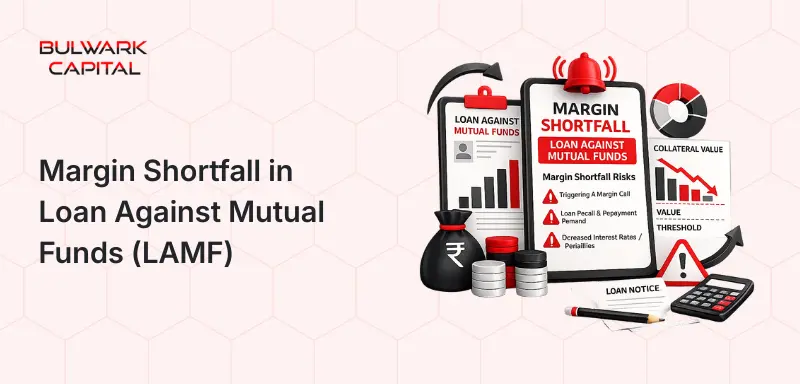
A margin shortfall happens the moment your outstanding loan exceeds that permissible LTV limit — because the NAV of your pledged funds has dropped.
Here is a clean example:
- Pledged portfolio value: ₹10,00,000
- Loan outstanding: ₹4,50,000 (exactly at 45% LTV)
- Market falls — portfolio drops to ₹8,80,000
- New permissible loan limit: ₹3,96,000 (45% of ₹8,80,000)
- Outstanding still: ₹4,50,000
- Shortfall = ₹54,000
That ₹54,000 gap is your margin shortfall. The lender will not ignore it.
One more thing worth understanding: your credit limit is the ceiling, not the target. If you borrow right up to your maximum eligible limit, even a 1–2% NAV dip can create a shortfall instantly. If you borrow only 60–65% of your eligible limit, your collateral can absorb a significant fall before any breach occurs.
How Does a Margin Shortfall Happen? The Mechanics
Daily NAV-Based Revaluation
Lenders do not check your collateral monthly. They revalue it every trading day at end-of-day NAV.
What that means practically:
- A 5–6% fall in equity fund NAV can silently push your LTV past the limit overnight
- The shortfall has nothing to do with your repayment behaviour — you could be paying interest perfectly on time and still face it
- Lenders can also do interim revaluations during steep market corrections — not just end-of-day — especially during sharp sell-offs
The Two LTV Levels That Matter
Most lenders operate on two thresholds — not one:
- Soft alert zone: LTV approaching the maximum limit — some lenders send an early heads-up here
- Hard breach: LTV has actually crossed the permissible limit — this is when a formal margin call gets issued and the margin shortfall penalty clock starts
Knowing the soft alert exists gives you a chance to act before the breach. Most borrowers only discover the system when the hard breach has already happened.
What Happens After a Margin Shortfall Is Triggered?
Step 1 — The Margin Call
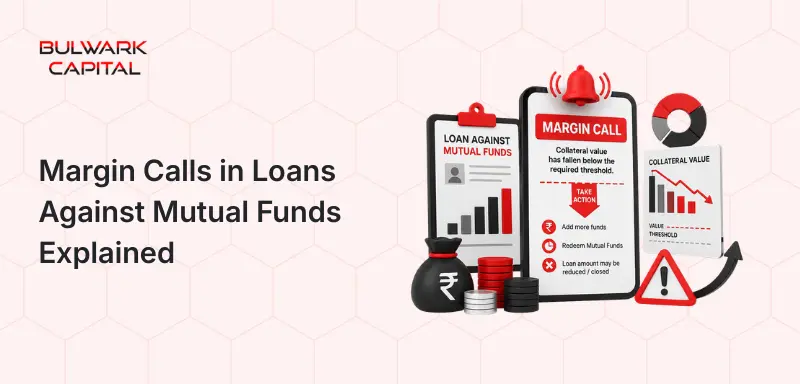
Once the system flags a breach, the lender issues a formal margin call — via email, SMS, or a call from their team.
RBI circular RBI/2021-22/88 sets out clear timelines:
- LTV breached but up to 60%: Borrower gets up to 7 working days to resolve the shortfall
- LTV crosses 60%: Must be resolved on the same day by 7:00 PM — no grace period
Step 2 — Your Three Options to Fix It
You are not stuck. You have real options:
- Pledge additional mutual fund units — increase collateral value so the LTV comes back within limits
- Make a partial principal repayment — reduce the outstanding amount to match the current eligible limit
- Do both — a smaller top-up combined with a partial repayment is often the fastest way to close the gap
Step 3 — Forced Liquidation If You Do Nothing
If the shortfall is not resolved within the given window, the lender has a legal right to redeem your pledged units — without asking for your consent.
The consequences:
- Units get sold at the current NAV, which is already depressed
- If sale proceeds fall short of your outstanding loan, you still owe the remaining due amount
- Your long-term investment position is broken permanently at the worst possible market moment
Lenders always prefer resolution over liquidation. But the right to liquidate exists — and they will use it if there is no response.
Margin Shortfall Penalty in LAMF — The Real Cost Breakdown
Regular interest is what you planned for. The margin shortfall penalty is what catches borrowers off guard.
Here is how it works:
- Penalty rate: Typically 1–2% per annum above your contracted loan rate — charged on the shortfall amount, not the full loan
- Daily accrual: It starts from the day the shortfall is detected and runs until you resolve it
- Runs alongside regular interest: Both charges apply simultaneously during the shortfall period
- Some lenders charge up to 2% per month on the excess overdue amount — that compounds fast
A quick illustration of what this actually costs:
| Shortfall Amount | Penal Rate (above contract rate) | Days Unresolved | Approx. Penalty |
| ₹50,000 | 2% p.a. | 7 days | ~₹192 |
| ₹1,00,000 | 2% p.a. | 7 days | ~₹384 |
| ₹1,00,000 | 2% p.a. | 30 days | ~₹1,644 |
The numbers look manageable in isolation. However repeated shortfalls — across multiple market corrections — stack up. And beyond the monetary cost, repeated LTV breaches may affect your standing with the lender. It signals over-leveraging and can restrict future borrowing with certain lenders.
Margin Shortfall vs Margin Call — Two Different Things
These two terms sound interchangeable. They are not.
| Term | What It Actually Means |
| Margin shortfall | The numerical gap — your outstanding loan minus what the current LTV permits |
| Margin call | The formal notice the lender sends you about that gap |
The shortfall is the problem. The margin call is the notification about the problem.
You can receive a warning (soft alert) before a real margin shortfall even occurs — when LTV is just approaching the breach level. That window is your best chance to act cheaply and quickly. Most borrowers who handle it at the soft-alert stage never end up paying any margin shortfall penalty at all.
Which Mutual Funds Create the Highest Shortfall Risk?
Not all pledged funds behave the same way when markets turn rough. It really comes down to how much the NAV moves on a bad day.
- Small-cap and mid-cap funds are the most vulnerable — these can drop 8–12% in a single week during a broad market sell-off. If you are already sitting close to your LTV limit, that swing creates a shortfall faster than most borrowers expect.
- Sectoral and thematic funds carry a different kind of risk. When that particular sector takes a hit — pharma, IT, PSU, realty — the NAV falls sharply even when the broader market is holding steady. The shortfall here is unpredictable and sudden.
- Large-cap funds are steadier by comparison. They do not swing as wildly, but a 15–20% broader market correction will still pull their NAV down — just more gradually than small or mid-cap funds.
- Hybrid and balanced funds sit in a more comfortable zone. Because part of the portfolio is in debt instruments, the NAV does not react as aggressively to equity market moves. The cushion is real.
- Debt funds are the safest collateral category. NAV movement here is slow and tied mostly to interest rate cycles — not daily market sentiment. A margin shortfall on a debt-heavy pledge is rare.
One thing most borrowers miss at the time of pledging — putting all your collateral into one fund type multiplies your exposure. A mix of equity and debt funds in your pledged portfolio makes the total collateral value far more stable. One category falls, the other holds.
How to Avoid a Margin Shortfall in Your Loan Against Mutual Funds
Most margin shortfalls are preventable. A few deliberate habits make the difference:
- Borrow 20–30% below your maximum eligible limit — Industry experts consistently recommend this buffer. It means your collateral can absorb market dips without breaching LTV
- Monitor your pledged portfolio NAV weekly — Most digital LAMF platforms show your current LTV, credit limit, and drawn amount on the dashboard in real time. Review these metrics regularly.
- Keep a dedicated margin reserve — Even ₹25,000–₹50,000 sitting in your savings account can resolve a moderate shortfall on the same day, before penalty kicks in
- Set NAV drop alerts on your AMC or investment app — A 5–7% portfolio fall alert gives you advance warning before it becomes a breach
- Pledge across fund categories — Adding debt fund units alongside equity funds stabilises the total collateral value and makes your LTV far less reactive to equity market swings
- Plan proactively around volatile market windows — Budget announcements, RBI policy decisions, global sell-offs — these are predictable high-risk windows. Consider a partial prepayment or additional pledge before these events if you are close to the LTV limit
Frequently Asked Questions (FAQs)
A margin shortfall in a Loan Against Mutual Funds is the gap between your outstanding loan amount and the maximum permissible borrowing based on the current NAV of your pledged units. It occurs when NAV falls and pushes your LTV above the allowed limit.
The margin shortfall penalty is a penal interest charged over and above your contracted loan rate — typically 1–2% p.a. on the shortfall amount. Some lenders charge up to 2% per month on the excess overdue amount. It accrues daily from the date the shortfall is detected until you resolve it.
As per RBI circular RBI/2021-22/88, if your LTV breaches but stays at or below 60%, you have up to 7 working days. If LTV crosses 60%, the shortfall must be resolved on the same day by 7:00 PM.
Yes. If the margin shortfall is not resolved within the stipulated window, the lender can redeem your pledged mutual fund units to recover the outstanding loan — without requiring your consent. This is called forced liquidation.
Borrow 20–30% below your maximum eligible limit, monitor portfolio NAV regularly through the lender dashboard, keep a small cash reserve for top-ups, pledge across fund categories, and act on soft alerts before a hard breach occurs.
Conclusion
A margin shortfall is not something that only happens to careless borrowers. It can happen to anyone who borrows close to their maximum limit and holds equity fund collateral during a market correction.
The difference between a borrower who handles it smoothly and one who ends up in forced liquidation is usually just awareness — knowing the system, keeping a buffer, and acting fast when an alert comes.
A well-structured Loan Against Mutual Funds is one of the most intelligent borrowing tools available to Indian investors today. The key is using it responsibly.
If you are looking for a lender who makes the process straightforward — with real-time portfolio visibility, transparent charges, and no hidden fees — Bulwark Capital is built exactly for that.
Fixed rate of 9% p.a., zero prepayment penalty, and same-day disbursal in under 4 hours. Your pledged units stay invested and keep compounding while you access the liquidity you need.
Check your loan against mutual funds eligibility for free at bulwarkcapital.in.