Mutual fund investors in India today have access to one of the most underused borrowing options in the market — a Loan Against Mutual Funds. You pledge your units, get a pre-approved credit line, and your investments continue to grow. No redemption. No capital gains tax. No disruption to long-term wealth creation.
What makes a loan against mutual funds India particularly compelling is the cost. Personal loans from the same lenders typically start at around 10% and commonly run to 22–24% per annum. A LAMF interest rate starts around 9% — that is a saving of 300 to 500 basis points on the same borrowing amount, simply because the loan is backed by collateral.
But the loan against mutual funds interest rate is not the only variable that determines your actual borrowing cost. The type of fund you pledge, the lender you choose, your relationship with that lender, and the LTV you opt for — all of these move the needle on what you actually pay.
This mutual fund loan interest rate comparison breaks it all down so you can make an informed decision.
What Is a Loan Against Mutual Funds and Why Interest Rate Comparison Matters
A Loan Against Mutual Funds is a secured credit facility where you pledge your mutual fund units as collateral with a bank or NBFC. The lender marks a lien on your units with the registrar — CAMS or KFintech — and gives you an overdraft credit limit based on the current portfolio value and the applicable LTV ratio.
Key features:
- Interest is charged only on the amount you draw, not the full sanctioned limit
- Your pledged units stay in your folio and continue earning returns
- Repay anytime — the credit line works like an overdraft
- No credit score check required with most lenders
Why the interest rate on loan against mutual funds comparison matters:
Two lenders quoting the same headline LAMF interest rate can have very different effective borrowing costs once you account for LTV, processing fees, renewal charges, and fund-type restrictions. The rate is the starting point — not the complete picture.
Current LAMF Interest Rate Range in India — 2026
Across banks and NBFCs in India, loan against mutual funds interest rates in 2026 range from approximately 9% to 13% per annum for equity fund pledges. For debt fund pledges, the rate is marginally lower — reflecting the lower NAV volatility and higher liquidity of debt instruments.
Prime borrower and platform rates
Dedicated digital LAMF platforms and fintech-enabled lenders typically start around 9% per annum for well-qualified borrowers. This is the floor for individual borrowers with clean credit profiles and mid-to-large portfolio sizes.
Why debt fund loans are structurally cheaper
- Debt mutual funds can be redeemed within one business day — lenders face almost no liquidity risk
- NAV of debt funds moves far less sharply than equity funds — margin call risk is lower
- This reduced risk translates directly into a lower mutual fund loan interest rate for debt fund pledges
One important caveat: the “starting rate” published by any lender is relationship based priced. What most borrowers actually get depends on their profile, portfolio size, and existing relationship with the lender. Always get the final quoted rate in writing before signing.
Bank LAMF Interest Rates — Who’s Offering What
Public sector banks *
SBI is the most prominent public sector bank offering LAMF, with interest rate starting at 9.99% per annum. The facility is accessible digitally via YONO for existing SBI account holders. SBI primarily focuses on debt mutual funds for this product — equity fund LAMF is available but with a more conservative LTV.
Key advantage for SBI borrowers: minimal documentation for existing account holders, competitive floor rate, and trust of a government-backed institution.
Private banks *
- ICICI Bank: 10.75% to 11.75% per annum on loan against equity mutual funds; higher LTV on debt funds (up to 80%). Digital disbursal within 2 working hours for ICICI account holders. Maximum credit limit of ₹1 crore for equity and debt MF combined
- Kotak Mahindra Bank (via digital platforms): Starting at 9.99% per annum, 36-month tenure, over 8,000 eligible schemes, zero foreclosure charges, digital onboarding
- HDFC and Axis: Relationship based priced at branch level; publicly disclosed rate bands broadly in the 9.5%–13% range for individual borrowers
What banks are generally better at:
- Lower floor rates for existing account holders — relationship based pricing works in your favour
- Higher LTV on debt fund pledges, particularly for large-ticket borrowers
- Better suited for high-value, prime borrowers with an established banking relationship
- Debt fund LAMF with no upper cap on loan amount in offline/branch channel (ICICI, for example)
NBFC LAMF Interest Rates — Who’s Offering What
Major NBFC and fintech LAMF players *
- Bajaj Finance: LAMF available across equity and debt fund categories; rate band typically in the 10.5%–12% range depending on fund type and borrower profile; ticket sizes ranging from ₹75,000 to ₹40 crores (offline channel)
- Tata Capital: Broadly in the 10%–12% range; digital channel processes up to ₹5 crores; offline facility available up to ₹40 crores
- Dedicated LAMF fintech platforms (Bulwark Capital, and others): Often start at 9%–10.5%, digital-first onboarding, broad fund universe (thousands of schemes across 30+ AMCs accepted)
What NBFCs are generally better at:
- Faster disbursal — often within 4 hours of completing digital onboarding
- Broader fund universe — NBFCs and digital platforms typically accept a wider range of AMC schemes than conservative bank approved lists
- Easier eligibility — income documentation requirements are lower; business entities (proprietorships, LLPs, trusts) are more easily served
- Larger ticket sizes for business borrowers requiring working capital against portfolio
The honest trade-off:
A slightly higher headline LAMF interest rate from an NBFC is often offset by the speed, flexibility, and the broader fund acceptance. For a borrower who needs funds within 4 hours against a diversified portfolio spanning multiple AMCs, a 30–50 bps higher rate is a reasonable trade for convenience.
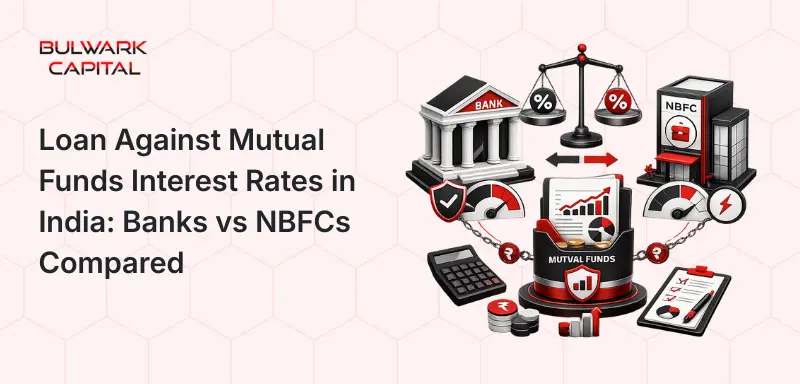
Banks vs NBFCs — Side-by-Side Rate and Feature Comparison
| Parameter | Banks | NBFCs / Digital Platforms |
| LAMF interest rate range | 9.99%–13% p.a. | 9.99%–13%+ p.a. |
| LTV on equity funds | 45%–50% (internal limit) | 45%–50% (internal limit) |
| LTV on debt funds | Up to 75%–80% | Up to 75%–85% |
| Processing fee | 0.25%–1% of sanctioned limit | ₹499–₹4,999 flat or up to 1% |
| Disbursal speed | 2–24 hours (digital); slower at branch | 2–6 hours (digital-first) |
| Fund universe accepted | Narrow — approved list only | Broad — thousands of schemes |
| Minimum ticket size | ₹25,000 | ₹25,000 |
| Maximum ticket size | Up to ₹1 crore (digital channel) | Up to ₹40 crores (offline) |
| Business entity lending | Limited | Available with more flexibility |
| Ideal borrower | Prime individual, existing customer | Flexible income, diverse portfolio |
Who wins on what:
Banks win when you are an existing account holder with a prime credit profile, borrowing against a large debt fund portfolio, and the relationship rate is below market.
NBFCs win when you need speed, accept units across many AMCs, are a business entity, or your portfolio is spread across fund houses not all on the bank’s approved list.
What Actually Moves Your LAMF Interest Rate
Type of mutual fund pledged
The single biggest driver. Loan against debt mutual funds attracts a lower rate than loan against equity mutual funds — and loan against SIP-accumulated equity units follows the same equity rate band. Fund type determines both the LTV and the risk pricing.
RBI’s revised LTV framework (February 2026)
The RBI issued revised directions in February 2026, significantly increasing LTV caps for mutual fund loans:
- Equity mutual funds and equity-oriented ETFs/REITs: LTV capped to 75% (regulatory maximum)
- Debt mutual funds: LTV capped tot 85%
- System-wide borrowing cap: ₹1 crore per individual across all lenders — effective from July 1, 2026 (implementation deferred from the original April 1, 2026 date)
Individual lenders may apply more conservative internal limits within these RBI caps — most banks currently apply 45%–50% on equity and 75%–80% on debt. But the revised regulatory ceiling gives significant headroom as the market matures.
Loan structure — overdraft vs term loan
Overdraft-based LAMF typically carries a slightly lower or equivalent rate to a term loan, with no prepayment penalty. The term loan LAMF (less common) is more structured but less flexible.
Borrower Relationship
Existing account holders at a bank often get relationship pricing — the rate quoted to a new-to-bank borrower is usually the ceiling, not the floor.
Loan quantum and tenure
Larger ticket sizes sometimes attract better rates at the negotiation stage, particularly for NBFC lending. Tenure beyond 12 months may require renewal at a revised rate.
Credit profile and income documentation
Most LAMF products do not require a formal income check. However, for higher ticket sizes (above ₹50 lakhs), some lenders request income proof — and a clean credit history supports better rate negotiation.
Loan Against SIP Investments and Equity Mutual Funds — Rate-Specific Notes
Can SIP-accumulated units be pledged?
Yes — SIP units accumulate over time and are eligible for pledge once they are unlocked (ELSS units have a 3-year lock-in; all other equity fund SIP units are generally eligible after purchase). There is no separate loan against SIP rate class — the applicable interest rate on loan against mutual funds is determined by the fund category, not how the units were acquired.
Equity mutual fund-specific behaviour
- Loan against equity mutual funds sits in the higher rate band — roughly 10%–13% p.a. across lenders
- Equity NAV is more volatile — a market correction can breach your LTV threshold quickly
- Lenders may require a top-up (additional pledge or partial repayment) if NAV falls and the outstanding loan exceeds the permissible LTV
- Keeping a buffer below your maximum drawdown limit reduces margin call risk during volatile markets
Loan Against Debt Mutual Funds — Why It Is the Cheapest LAMF Option
Rate band for debt fund pledges
Loan against debt mutual funds consistently attracts the lowest LAMF interest rate — typically 50 to 100 basis points lower than equivalent equity fund loans at the same lender, depending on their internal pricing policy.
Why lenders price debt fund loans lower:
- Debt funds can be redeemed within T+1 — liquidation risk for the lender is minimal
- NAV of debt funds is far less volatile than equity — LTV breach risk is significantly lower
- Higher LTV (up to 85% under the new RBI framework) means more borrowing against the same portfolio value
Best-fit use case:
A loan against debt mutual funds is ideal for investors who hold liquid funds, short duration funds, or corporate bond funds and need short-term liquidity without disturbing their debt allocation. The combination of a lower interest rate, higher LTV, and minimal margin call risk makes this the most cost-efficient LAMF structure available.
Hidden Costs That Change Your Effective Rate
The quoted mutual fund loan interest rate is not the total cost. Add these:
- Processing fee: 0.25% to 1% of sanctioned limit or ₹499–₹4,999 flat + GST — paid upfront
- Annual maintenance / renewal fee: ₹500–₹2,000 per annum + GST — recurring for multi-year facilities
- Margin call obligations: If NAV drops and LTV is breached, partial repayment or additional pledge is required within 7 days — failing which the lender may liquidate units
- NACH bounce charge: ₹500–₹1,200 per failed auto-debit + GST
What does not cost anything with most overdraft LAMF products: prepayment or foreclosure charges — nil with most lenders including Bulwark Capital, Kotak (via platforms), and Tata Capital digital.
When comparing,
calculate the effective rate = interest paid + all fees ÷ average drawn balance × 100.
Two lenders with the same headline rate can land very differently on this number.
How to Choose Between a Bank and an NBFC for LAMF
Quick decision checklist:
- Existing bank customer with prime profile and large debt fund portfolio → Bank first. Relationship pricing and higher LTV on debt funds work in your favour
- Need funds within 4 hours, portfolio across multiple AMCs → NBFC or digital platform. Faster disbursal and broader fund acceptance
- Business entity (proprietorship, LLP, trust) needing working capital → NBFC. More flexible documentation and entity lending norms
- Equity fund portfolio, mid-size ticket (₹5L–₹50L) → Bank or NBFC both viable — compare on total cost including processing fee and renewal charge
- Loan amount likely to exceed ₹1 crore across all lenders → Note the new RBI system-wide cap of ₹1 crore per individual effective July 1, 2026 — plan accordingly
- Want zero prepayment charges and maximum flexibility → Confirm with lender before signing — most overdraft LAMF products offer this, but verify
Conclusion
The loan against mutual funds interest rate in India in 2026 ranges from around 9% to 13% per annum — significantly cheaper than personal loans, credit lines, or unsecured borrowing at the same tenure. But rate alone is not the full picture.
What you actually pay depends on the type of mutual fund you pledge, your lender category, the LTV you operate at, and the fee structure layered on top of the headline rate. A loan against debt mutual funds will cost you less than a loan against equity mutual funds at the same lender. A bank relationship may give you a better floor. An NBFC may give you speed and a broader fund universe.
The right LAMF interest rate is the one that fits your fund type, your timeline, and your total borrowing cost — not just the number on the lender’s homepage.
Bulwark Capital is an RBI-licensed NBFC offering digital Loans Against Mutual Funds at a fixed 9% per annum — with interest charged only on the amount utilised, zero prepayment charges, nil lien marking fees, and full disbursal typically within 4 hours. Across equity and debt fund categories, the process is 100% digital from lien marking to credit line activation.
Check your Loan against mutual funds eligibility at bulwarkcapital.in and find out how much your mutual fund portfolio can unlock for you — without redeeming a single unit.
*Disclaimer: Rates, terms, eligibility, and lender offerings may change. Please verify details with the respective lender before making any financial decision. We do not guarantee approval or outcomes from any lender.